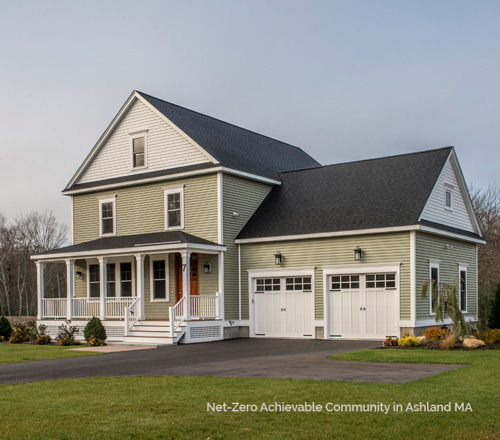
More and more homeowners are interested in the financial and environmental benefits of eco-friendly and sustainable building practices. Whether you're looking to make some small meaningful steps forward or go completely green, GMT Home Designs has the expertise to help guide you through the process.
Design and construction practices that meet specified standards, resolving much of the negative impact of buildings on their occupants and on the environment.
GMT Home Designs can help you make the most sustainable choices for your project in the areas of:
Green building has multiple direct environmental and economic benefits to homeowners and to society as a whole, including:
GMT Home Designs can build sustainability considerations into your residential or commercial construction project, from the first design steps through final construction. Our experience with the New England's variable wind, soil, ocean climate, seasons and more will help guide you to the best decisions for your location. We are familiar with state and local permitting and other construction requirements from Southern Connecticut to Bar Harbor, Maine and beyond.
Choose sustainable building materials, reduce energy use and cost, lower environmental footprint — contact us to discuss your remodel or new construction, and set up a site consultation to learn more about the possibilities of your specific project.
Sustainable design means creating homes that are energy-efficient, environmentally responsible, healthy to live in, and resilient against New England's challenging climate—while remaining beautiful and functional.
For your New England home specifically, this translates to practical strategies:
Sustainable design isn't about sacrifice—it's about smarter design that saves money, improves comfort, reduces environmental impact, and creates healthier homes. In our region, where energy costs are high and climate challenges are real, sustainable design is practical economic sense as much as environmental stewardship.
Well-designed sustainable features typically add 3–8% to upfront construction costs but deliver 15–30% energy savings annually, meaning payback within 5–10 years and ongoing savings for the life of your home.
Many people assume "green building" means expensive exotic materials or cutting-edge untested technology. In reality, most sustainable design uses proven, readily-available products and construction methods—just applied more thoughtfully.
GMT's approach: We don't push every green feature regardless of cost. We identify strategies with the best ROI for your specific situation, climate zone, and budget. Sometimes spending $8K on better insulation makes more sense than $8K on exotic finishes. We help you prioritize investments that improve your life while making financial sense.
Yes—"deep energy retrofits" can transform existing New England homes from energy hogs into high-performance, comfortable residences, often achieving 40–60% energy reductions.
You don't need to do everything at once. We often recommend prioritizing improvements in phases:
Historic homes may have preservation restrictions limiting exterior changes. We work within those constraints using interior improvements and compatible materials—our experience in older New England towns and homes really pays off here.
Load-bearing walls, complicated wiring and plumbing, and unknown conditions behind walls make retrofits more complex than new construction. We carefully assess what's feasible without destroying character or exceeding budgets. Phased approaches let you spread investment over several years while capturing savings along the way.
MassSave, Rhode Island Energy, and other regional programs offer rebates, zero-interest loans, and incentives for efficiency improvements that can offset 20–40% of project costs. We help you understand available programs and ensure work qualifies.
The reality: Most New England homes built before 2000 are prime candidates for efficiency improvements. Even homes from the 1990s and 2000s have significant room for improvement given advances in insulation, air sealing, and HVAC technology.
Yes—we have experience with both Net Zero Energy homes (producing as much energy as they consume annually) and Passive House principles (an ultra-low energy design standard). What's critical is that we are practical about when these approaches make sense for New England homeowners.
Passive House is a rigorous German building standard focused on exceptional envelope performance, minimal thermal bridging, and controlled ventilation:
With solar incentives and energy savings, payback for the homeowner has typically been 12–15 years. As energy costs rise, this equation improves and investment is recouped faster.
Our climate requires significant heating energy while limiting solar production during winter months when needs are highest. Historic neighborhoods sometimes restrict solar installations. These are real considerations we'll assess honestly for your specific site.
For clients deeply committed to environmental performance, willing to invest the premium, and interested in the verification process. Certification requires detailed energy modeling, quality assurance testing, and meeting strict performance thresholds.
We're pragmatists. Many clients benefit from Passive House and Net Zero principles without pursuing full certification. Investing in an exceptional envelope, efficient systems, and thoughtful design captures most benefits at lower cost than formal certification. Much of New England has also adopted fairly strict energy efficiency requirements in standard building codes, meaning a well-designed "pretty good house" can deliver 70–80% of the energy performance at a much lower cost premium.
What we don't do: push expensive certifications or extreme measures that don't align with your priorities. Sustainable design should enhance your life and match your values—not become an end unto itself that compromises function or affordability.
If high-performance building interests you, let's discuss your goals during the site consultation. We'll provide honest feedback about what's achievable, what it costs, and whether it aligns with your vision for your home.