3D Renderings & Virtual Reality

Step into your design

Imagine having 100% confidence that you are getting the design of your dreams, the features you want — even confirmation that your color choices will work under different lighting conditions. Welcome to 3D rendering and virtual house tours.

GMT Home Designs makes these virtual tours possible for every project, allowing our clients to experience their future space in realistic scale, with accurate lighting, and material lists for each element of the architectural design. We create our floor plans and site plans in Chief Architect, the industry's most powerful software for designers and builders. This lets us fully discuss the plans with you and even make quick changes and adjustments on the spot, as you walk through the design and view it from different angles. Together we'll refine and perfect the outcome before ever breaking ground on the building work.

You'll have confidence because you don't have to imagine the results. Cost estimating is faster and more accurate. You save time and money. And the whole team is on the same page about exactly what we are building.

Overall, this accelerates the design and construction phases, so you are celebrating and living in your completed project as soon as possible.

Know What You're Getting with VR Walkthroughs

From first discussion, to an on-site consultation at your construction location, all the way through virtual tours and final project completion, GMT Home Designs focuses on collaboration and clear communication with our clients and construction partners. You'll know who you are working with, what to expect from the process, and what your new spaces will look like.

Let us show you how we perfect the design of your dreams. Call us at 508-881-7992 or send an e-mail to info@gmthomedesigns.com today.


Ready to see your vision come to life?

Visit our YouTube Channel to see additional walk through videos.

Render to Reality
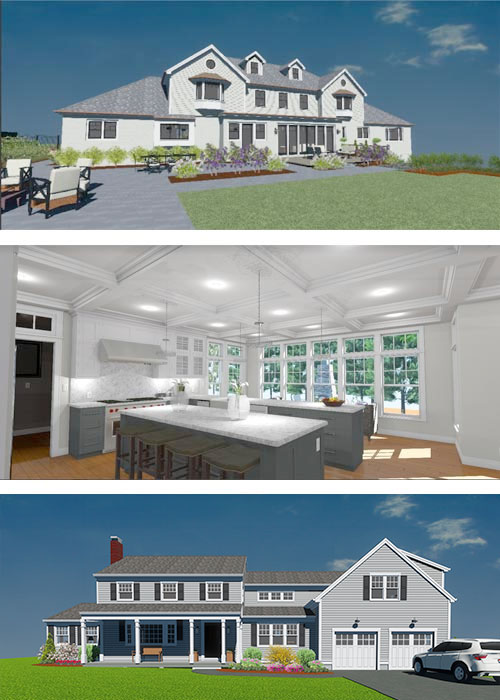
Extremely realistic—our Chief Architect renderings show true-to-scale spaces with accurate lighting, actual material textures, and precise spatial relationships. Clients consistently tell us "it looks exactly like the rendering" when projects complete.

What makes our renderings so accurate:

True scale and proportions: Unlike artistic "concept sketches," our 3D models are built from actual construction dimensions. When you see a 10-foot ceiling or 4-foot-wide island in the rendering, that's precisely what you'll get. There's no interpretive guesswork involved.

Realistic lighting simulation: Chief Architect models natural light based on your property's actual location, orientation, and time of day. We can show you how morning sunlight enters your kitchen or how afternoon light affects your living room. We also simulate artificial lighting from your chosen fixtures.

Actual materials and finishes: We incorporate specific products—real cabinet lines, actual flooring products, genuine tile patterns, specific countertop materials. The rendering shows your selected materials, not generic placeholders.

Spatial flow and sightlines: You can see how rooms connect, what you'll view from various locations, how tall ceilings feel, and whether spaces feel open or intimate. This prevents the common disappointment when clients realize too late that their "open concept" feels different than imagined.

What renderings can't perfectly capture:

  • Exact color matching under all lighting conditions (colors shift with natural light throughout the day)
  • Subtle material texture details (fabric weaves, stone variation, wood grain specifics)
  • How spaces "feel" emotionally—warmth, coziness, grandeur (though we get remarkably close)

The real power: Renderings let you make design decisions with confidence. Should that wall between the kitchen and dining room come down? The rendering shows you exactly what you'll gain and lose. Unsure about vaulted ceilings? You'll see whether the drama is worth the cost. Debating island size? We model different options so you choose based on visualization, not guesswork.

Result: Clients experience their space virtually, make informed decisions, and complete projects without the "I wish we had done that differently" regrets that plague projects designed only on paper.

Yes—and this is one of the most valuable parts of our design process. We create multiple rendering alternatives so you can compare options side-by-side before committing to final plans.

Common design alternatives we model:

Layout options: Open vs. defined spaces, kitchen work triangle variations, room size trade-offs (larger kitchen vs. larger dining area).

Architectural features: Vaulted vs. standard ceilings, different window configurations, fireplace locations, built-in cabinetry alternatives.

Material and finish selections: Cabinet styles, countertop materials, flooring types, backsplash patterns, exterior siding and trim combinations.

Spatial configurations: Furniture placement, traffic flow patterns, how different space planning affects functionality.

Exterior elevations: Different rooflines, siding materials, window styles, porch configurations, garage door options.

How the process works:

We don't immediately render every possible variation—that would be overwhelming and inefficient. Instead, we develop an initial design based on your stated preferences and site requirements. Then we render that design so you can evaluate it.

From there, you'll often say "I love this, but what if we..." That's when we create alternative renderings showing different approaches. Usually, 2-3 rendered alternatives for major decisions (layout, major architectural features) and quick variations for finish selections.

The advantage of real-time rendering:

During design meetings, we can often create alternative renderings on the spot. "What if we made this window larger?" We adjust the model and show you within minutes. This interactive process means you're not waiting weeks between meetings to see how different ideas look.

The result: You choose based on actually seeing options, not trying to mentally visualize what's described verbally or shown in flat 2D plans. This leads to confident decisions and projects that match your vision.

Cost implications: Alternative renderings are included in our design fees for major decisions. If you want to see 10+ different finish combinations or explore radically different designs, we'll discuss whether additional modeling time is needed—but we keep the process collaborative and cost-conscious.

3D rendering frontloads design decisions, eliminates costly mid-construction changes, and ensures everyone's aligned on expectations—resulting in faster timelines, fewer change orders, and reduced construction stress.

Specific ways renderings save money:

Change order reduction (20-40% savings): The #1 construction budget-killer is mid-project changes. "I didn't realize the island would feel this large," "Can we make that window bigger?" "I don't like how this looks now that it's framed." Every change costs time and money—labor, material waste, schedule delays, contractor markup.

When clients have walked through their space virtually and approved every detail, change orders plummet. They've already seen the island size, window configuration, and spatial flow. No surprises means no expensive corrections.

Accurate initial budgeting: Builders can price precisely from detailed renderings and complete materials lists. Vague concepts lead to rough estimates with 15-25% contingency padding. Specific designs let contractors provide tight, accurate bids—and you'll know whether you can afford your vision before investing in construction documents.

Value engineering BEFORE construction: During rendering review, you might realize that expensive feature isn't as impactful as anticipated, or spot opportunities to simplify details without sacrificing design quality. Making these decisions virtually costs nothing. Making them after framing begins costs thousands.

Faster client decisions: Homeowners approve designs more quickly when they can see what they're getting. Less "let me think about it" delays that extend timelines. Time is money—longer projects mean higher holding costs, more builder coordination challenges, extended disruption to your life.

Reduced contractor questions during construction: Clear, detailed renderings mean builders understand design intent. Fewer "what did you mean here?" phone calls, fewer RFIs (requests for information), fewer construction delays waiting for clarification.

Preventing expensive mistakes: A rendering might reveal that your planned furniture won't fit the room layout, or that sight lines don't work as imagined, or that proportions feel off. Discovering these issues virtually prevents tearing out completed work—which we've seen cost $15K-$50K+ to fix.

Faster permitting: Building departments increasingly appreciate 3D renderings that clearly communicate design intent. Some municipalities now request them. Clear communication reduces plan review delays and revision requests.

Time savings: Projects move faster when everyone's aligned. Decision paralysis disappears when you can see options. Construction proceeds smoothly when there's no ambiguity. Most clients report GMT projects complete 2-4 weeks faster than previous projects they've undertaken without visualization.

We create initial renderings early in the design development phase—after we understand your needs and site constraints but before finalizing construction documents. This timing maximizes rendering value while keeping the process efficient.

The typical timeline:

Phase 1: Discovery (weeks 1-2)
  • Site consultation
  • Needs assessment
  • Preliminary concept discussions
  • Space planning fundamentals
  • No renderings yet—we're still gathering information
Phase 2: Schematic Design (weeks 3-4)
  • Initial floor plan layouts
  • Basic spatial relationships
  • Rough massing and proportions
  • Still primarily 2D work establishing the foundation
Phase 3: Design Development (weeks 5-8) — RENDERING HAPPENS HERE
  • Once floor plans are roughed out, we create 3D models
  • First renderings show exterior elevations and key interior spaces
  • You review, provide feedback, request alternatives
  • We refine and render revised options
  • This is the collaborative, iterative phase where your input shapes final design
Phase 4: Construction Documents (weeks 9-12)
  • After renderings are approved, we complete detailed construction plans
  • Final materials specifications
  • Technical details and annotations
  • Permit-ready documentation

Why this sequence matters:

Too early: Creating renderings before basic space planning is complete wastes time. If we're still figuring out room sizes and layout fundamentals, rendering prematurely means redoing work as the design evolves.

Too late: Waiting until construction documents are nearly complete defeats the purpose. By then, you've invested heavily in detailed plans that are harder to revise. The goal is to finalize design direction BEFORE investing in detailed documentation.

The sweet spot: Render when the concept is solid enough to visualize but flexible enough to adjust based on what you see. This is when renderings provide maximum value—confirming good decisions and catching issues while changes are still easy.

Rendering updates:

If you request significant design changes after initial renderings, we create updated renderings showing the revisions. This ensures you're always approving what you'll actually get, not outdated concepts.

Final renderings: Before construction begins, you'll have approved renderings that match final construction documents. These become the visual reference everyone—you, your contractor, subcontractors—uses to understand design intent throughout construction.

Special situations:

  • For very complex projects (large custom homes, intricate renovations), we might do preliminary rendering sketches even earlier to test major architectural concepts.
  • For simple projects (straightforward additions, basic renovations), we might complete renderings more quickly and move to construction documents faster.
  • We adapt the process to your project's specific needs and complexity.

Absolutely—many clients find additional valuable uses for their renderings beyond the design process itself.

Common uses for your renderings:

Contractor bidding (for design-bid-build projects): Include renderings with bid packages so contractors understand design intent and can provide more accurate pricing. Builders appreciate seeing what they're bidding on, not just interpreting 2D plans.

Financing and appraisals: Banks and appraisers increasingly request renderings for construction loan approvals, especially for custom homes or major renovations. Renderings help lenders understand the project scope and finished value.

Permitting and zoning approvals: Submit renderings with permit applications to help building departments and planning boards visualize your project. This is especially valuable for projects requiring variances, special permits, or architectural review board approval.

HOA or historical commission approvals: Many neighborhoods and historic districts require architectural review. Professional renderings demonstrate how your project will look and fit the neighborhood character—dramatically improving approval odds.

Pre-selling or leasing (for investment properties): If you're building rental units or planning to sell upon completion, use renderings for marketing before construction finishes. Pre-lease apartments or generate buyer interest while still under construction.

Furniture planning and interior design: Use renderings to plan furniture purchases, visualize how pieces will fit and look, and coordinate with interior designers. Prevents buying furniture that doesn't fit or suit the space.

Personal excitement and anticipation: Frame renderings during construction as a reminder of what's coming. Some clients create "vision boards" for their project. It maintains enthusiasm during the messy construction phase!

Portfolio for future projects: Keep renderings if you plan additional renovations or additions later. Shows future architects or contractors what you accomplished and your design aesthetic.

Social media and personal documentation: Share your project journey on Instagram, Facebook, or personal blogs. Before-and-after progressions including renderings tell a compelling story.

You own the renderings: Files belong to you once the project is complete. Use them however you wish—though we appreciate credit "Designed by GMT Home Designs" if sharing publicly!

File formats we provide: High-resolution JPEGs suitable for printing (great for framing), PDFs for easy sharing, and sometimes specific formats if you need them for particular applications.